When the power cut out and his signal dropped, TJ knew something was wrong.
Seconds later, the banging started on his front door. Terrified, he stood as still as possible with his wife and three-year-old daughter, hoping they wouldn’t be noticed.
But the Chinese police officers broke down the door, shoved his wife and child into a separate room and began to question TJ.
“They grabbed my clothes and grabbed my hands so I couldn’t move. I could hear my daughter crying so much in the room next door but I couldn’t go to her, I couldn’t hug my wife,” he told The Telegraph.
TJ knew what his family’s crime was: being Christian and worshipping a God that was not Xi Jinping. In China, following a church that is not state-controlled is punishable.
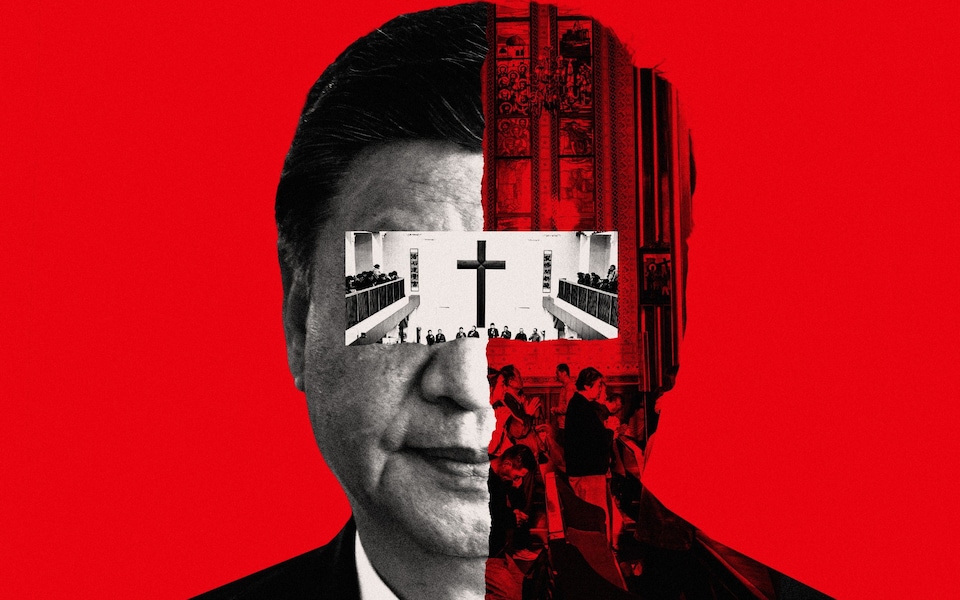
The Chinese leader is intensifying Beijing’s crackdown on Christians amid a wider purge of top officials, showing signs of an increasingly paranoid leader.
The country officially recognises five religions, including Protestantism and Catholicism, but this only extends to churches that are fully state-controlled, where congregation is expected to sing patriotic songs before every service and affix Mr Xi’s portrait above the pulpit.
Many Christians such as TJ, who withheld his full name for security reasons, and his wife have chosen to join unofficial churches – or underground churches – where they can preach the gospel away from the government’s oversight.
But attending these places of worship carries its own risks – not least because they are seen as traitors.
TJ last saw his wife when she was taken to a police station along with their phones, some books and artwork, and she has yet to be released. He still doesn’t understand why he was not taken too.
Under Mr Xi’s iron-tight grip, China has expanded its nationwide suppression of Christians during the last decade, arresting more than 10,000 people, according to Bob Fu, the founder of ChinaAid, a charity for victims of persecution in the country.
In the most recent crackdown, armed police stormed the Early Rain Covenant, an influential underground church, and detained more than 30 members last month.
Mr Xi’s ruthless campaign against these underground churches aims to ensure the survival of the Chinese Communist Party (CCP) and remove any threat to his power.
Mr Fu said: “It’s the emperor playing God. [Mr Xi] wants to be exclusive, he doesn’t want to have anything treated or worshipped more superior than him.”
TJ is one of six Chinese Christians who spoke to The Telegraph who have either been directly targeted by the CCP or have close relatives that are incarcerated.
They described police officers showing up at their homes unannounced in the middle of the night. Friends being rounded up and questioned by authorities, sometimes for weeks on end. Loved ones being convicted on trumped-up charges such as “using superstition to undermine the law” and detained indefinitely in crammed, dirty cells. And lawyers were targeted and suspended from practising law for defending Christians.
Knocks at the door
Jun Yang, a pastor with Zion Church, one of the largest underground churches in China, knows all too well about the risk of living as a Christian in China.
Nearly 30 members of his church, including Qu Qiuyu, his wife, and Ezra Jin Mingri, the church’s leader, were detained in October last year during one of the largest raids against Christians in recent years.
Mr Jin was released in early July, but many of those detained remain in prison.
Founded in 2007, Zion Church used to operate in a converted nightclub in Beijing but was forced to move to a decentralised, hybrid format 10 years later after the mass arrests of Christians across the underground church network and restrictions during the Covid-19 pandemic forced many of the church’s sessions online.
The church’s membership has grown from 1,500 in 2018 to around 5,000 followers now, since the church adopted the hybrid format.
Mr Yang and other Zion Church members who spoke to The Telegraph said the arrests in October were not a complete surprise.
Police had been harassing church members for months before the arrests and had been coming up with incriminating information about the church leaders.
In Mr Yang’s case, they were trying to pin corruption charges on him.
“The police reached out to church followers, even took them back to the police station for questioning. They asked them about donations to the church, whether such donations went into my pocket to buy apartments, or if I had misused them in any way,” he said.
“They were trying to look for excuses to see if they could set a trap for me,” he added.
Mr Yang was visiting South Korea when they raided his family home. Officers arrested his wife and hauled her away in front of their two young children.
Gao Yingjia, another pastor from Zion Church, was also targeted in the October 2025 raids, using similar tactics.
His wife, Geng Pengpeng, told The Telegraph that they had been awoken at 1.30am by loud knocks on the door. The police stormed in, handcuffed her husband and took him away.
“We both knew something like this might happen,” said Ms Geng. “All of our rental [church] locations were shut down and sometimes they would take someone to the detention centre for a week or 15 days.”
Neither Ms Geng nor Mr Yang has spoken to their spouses since they were detained.
For Mr Yang, while he counts himself lucky in some ways, he would do anything to go back in time. “If there was the chance, I would rather be the one arrested than my wife,” he said.
But as much as he wants to see his wife and children, he knows he may never get the chance to return to China.
“I am on the wanted list of religious practitioners so if I return to China I would be arrested,” said Mr Yang.
A threat to the throne
While Christians have long been treated as outsiders in China, when Mr Xi came to power in 2012, he piled on policies to further assimilate Christians and other religious groups in the country.
In 2015, he launched a “Sinicisation” campaign, which forced all religious and ethnic groups to assimilate and prioritise loyalty to the CCP over individual religious beliefs.
The same Sinicisation policy has been used to imprison and torture Uyghur Muslims in what has been characterised by many human rights organisations as genocide.
In 2018, Beijing rolled out a five-year plan to target Christians, which included censoring sermons, controlling church donations, supervising Bible translations and including “Xi Jinping Thought” in the curriculum of seminary schools.
They also systematically closed underground churches and demolished houses of worship as part of the campaign against worshippers outside the state’s control.
Those who agreed joined China’s two official churches – the Catholic Patriotic Association and the Protestant Three Self Patriotic Movement – while the rest remained part of the underground church network.
Today, there are an estimated 44 million members of the state-sanctioned church and around 115 million unregistered Christians, which are expected to double by 2030.
“My dad was approached many times about the [Three Self churches], and he said no, just like many others because they’re fake churches, to put it bluntly,” said Gao Pu, the son of Gao Quanfu, the incarcerated founder of the Light of Zion Church (different from Zion Church), and Pang Yu.
Experts note that Mr Xi’s Sinicisation campaign and the registered churches aim to remove any threat to the Communist Party’s stronghold over the country.
“On paper, the CCP is still an atheist entity so there’s an element where they fear what they cannot control and don’t understand – or don’t want to understand,” explained Mr Gao.
“Anybody that’s possibly out of their control, they tend to crack down on them very, very fast. They learnt the lessons from the past,” he said, referring to the 1989 student uprisings that were met with violent responses by police at Tiananmen Square.
Weaponising the court
Under the Sinicisation policy, Chinese police have arrested Christians and isolated them in detention.
Many of those arrested, including Mr Yang and Ms Geng’s spouses, were initially charged with the “illegal use of information networks”, a law that broadly covers any communication connected to “illegal or criminal acts”.
Typically, the charge carries a maximum sentence of three years, but is often combined with additional charges that can carry up to life imprisonment.
Authorities have also accused Christians of “using superstition to undermine the law”, for which the sentence can range from three years to an “indefinite imprisonment”.
However, in some of the cases described to The Telegraph, including those of Ms Geng’s husband and Mr Gao’s parents, authorities adapted the initial charges to fraud instead.
“They change to fraud because it’s much easier for them to slap a number on there and give a sentence, which is actually very heavy,” said Mr Gao.
He told The Telegraph that he did not know how long his parents would be in prison. While they could face more than 10 years, he hopes, given their age – both are in their late 60s – they will be released after only three years.
For Mr Yang’s wife, the charge was updated to illegally operating a business, which carries a longer sentence. However, Mr Yang has no idea how long the sentence will be.
Part of the uncertainty around sentencing is because of a lack of fair legal representation.
Several people who spoke to The Telegraph said that the government had revoked the licences of lawyers who had been hired to represent Christians.
Zhang Kai, whose law firm was working with many of the Zion Church members, including Mr Jin, had his licence revoked recently because he allegedly “disrupted order in the court”.
Several other lawyers at his firm were also forced to step down, including those working on Mr Yang’s wife’s case.
The Chinese government has previously targeted lawyers who have taken on politically sensitive cases, with some suspended and others thrown in prison.
Between 2017 and 2023, at least 30 human rights lawyers had their licences revoked, according to Frontline Defenders, the Irish human rights organisation.
In response to The Telegraph, a spokesman from the Chinese embassy in the UK said it “manages religious affairs in accordance with the law”.
They added that “anti-China forces” had used the guise of religious freedom and human rights to engage in “political manipulation, made sweeping generalisations, maliciously maligned China’s ethnic and religious policies, and fabricated and disseminated disinformation”.
They also said that “judicial organs in China handle cases strictly in accordance with the law and fully safeguard the lawful rights of criminal suspects and defendants throughout judicial proceedings”.
For those watching from a distance as this reality unfolds, it is hard to imagine the circumstances improving any time soon.
Ren Ruiting, a member of the Early Rain Covenant Church who fled to the US following the 2018 crackdowns, said that even thousands of miles from China, she still felt the watchful eye of the CCP.
“If I speak out, they’ll know immediately and they have some way to make me feel bothered and make me feel bad,” said Ms Ruiting.
Like Mr Yang, she doesn’t think she will ever go back to China.
“Once Xi Jinping is still the chairman in China, I don’t think anything will be better and if the persecution is not better, that means we cannot have our church and we are in danger anytime.”
We’ve got the edge. Get real-time reports, breaking scoops, and exclusive angles delivered straight to your phone. Don’t settle for stale news. Join NaijaChoice NEWS on WhatsApp for 24/7 updates →
Join Our WhatsApp Channel