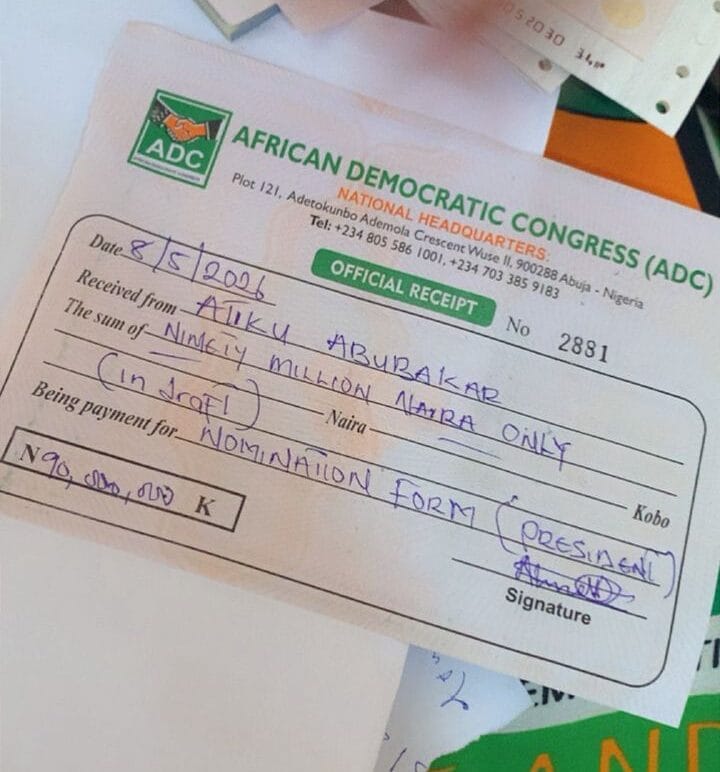
Former Vice President Atiku Abubakar has taken a decisive step towards the 2027 presidential race by securing and paying for his nomination forms under the African Democratic Congress (ADC), signalling a major consolidation within Nigeria’s opposition ranks.
The development, confirmed by the ADC on Saturday, positions the seasoned politician firmly within a party that has emerged as a key platform for anti-APC forces following the fragmentation of the Peoples Democratic Party (PDP). Formal presentation of the forms is scheduled for Monday, May 11, at the party’s national secretariat in Abuja.
Atiku, who served as Nigeria’s vice president between 1999 and 2007 under President Olusegun Obasanjo, has contested the presidency multiple times, most recently in 2023 under the PDP banner where he came second to Bola Tinubu of the All Progressives Congress (APC). His move to the ADC late last year came after prolonged internal crises in the PDP, joining other prominent figures seeking a viable alternative platform.
The ADC, once a relatively low-profile party, has gained significant traction as a vehicle for broader opposition coalitions. It now counts influential leaders including former Senate President David Mark among its ranks, and has been central to recent efforts by opposition parties to present a united front against President Tinubu’s expected re-election bid.
Nigeria’s political landscape ahead of the January 2027 elections remains highly fluid. Economic hardships, persistent insecurity, and questions over governance have fueled public demand for credible alternatives. Many Nigerians, particularly in urban centres and among the youth, continue to express frustration over rising living costs and infrastructure deficits three years into the current administration. In this environment, opposition realignment is viewed by analysts as an attempt to avoid the vote-splitting that characterised the 2023 polls.
Atiku’s payment of the nomination fee—reportedly in the region of N90 million—underscores his seriousness and the resources available to major contenders. It also highlights the financial barriers that often shape Nigeria’s political contests, where only well-established figures or those with deep networks can comfortably participate at the presidential level.
This latest move fits into a pattern of strategic repositioning. Since leaving the PDP, Atiku has signalled willingness to operate within a collective opposition framework, including openness to consensus or primaries within the ADC. Broader opposition summits, such as the recent gathering in Ibadan, have seen parties commit to working towards a single presidential candidate to maximise chances against the ruling APC.
Deeper Implications
The ADC’s growing profile reflects the ongoing reconfiguration of Nigeria’s opposition politics. With several heavyweight politicians now associated with the party or allied platforms, the 2027 contest could test whether personal ambitions can be subordinated to collective strategy. Success in forging unity would mark a departure from past opposition failures, potentially reshaping the two-horse or multi-candidate dynamics that have defined recent presidential races. The formalisation of Atiku’s candidacy bid adds clarity to the emerging line-up while keeping the door open for intra-party processes.
As the formal presentation of forms unfolds on Monday, all eyes will remain on how this development influences momentum within the ADC and across the wider opposition spectrum. In a democracy where voter apathy and economic discontent loom large, such moves carry weight far beyond party secretariats. They speak to the persistent search for effective leadership capable of addressing Nigeria’s complex challenges.
We’ve got the edge. Get real-time reports, breaking scoops, and exclusive angles delivered straight to your phone. Don’t settle for stale news. Join NaijaChoice NEWS on WhatsApp for 24/7 updates →
Join Our WhatsApp Channel