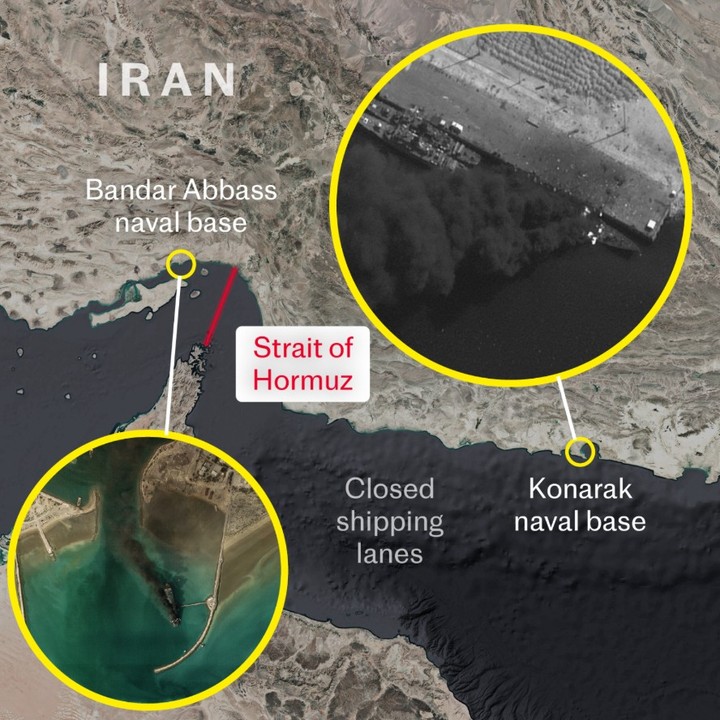
US and Israeli forces have annihilated the Iranian Navy’s southern fleet, leaving its headquarters at Bandar Abbas engulfed in thick black smoke and its prized warships burning or sunk in the Gulf of Oman.
Four days into the ongoing US-Israeli military campaign codenamed Operation Epic Fury, which began on February 28, 2026, the once-formidable Iranian naval power stands decimated. United States Central Command (CENTCOM) declared on Monday that all 11 Iranian vessels stationed in the Gulf of Oman have been completely destroyed, with President Donald Trump hailing the strikes as a key objective to neutralise Tehran’s ability to threaten vital sea lanes.
Satellite images released by Planet Labs and analysed widely across global media paint a grim picture. Before the attacks on February 22, Google Earth showed at least 11 large Iranian naval ships, including vessels from both the regular navy and the elite Islamic Revolutionary Guard Corps (IRGC) Navy, neatly docked at Bandar Abbas alongside dozens of smaller craft. The latest images reveal the same area shrouded in dense smoke, with what appears to be the smouldering wreckage of Iran’s largest vessel, the IRIS Makran, clearly visible in the bottom-right corner.
Built from a converted oil tanker under sanctions that crippled its military modernisation, the Makran had been touted by Tehran as a major forward base capable of launching drones and supporting long-range operations. US forces also confirmed strikes on the IRIS Shahid Bagheri, Iran’s drone and helicopter carrier commissioned just last year.
In a separate Israeli airstrike, senior IRGC figure and Defence Council Secretary Ali Shamkhani – a veteran admiral with deep roots in the Revolutionary Guard’s naval command – was killed, dealing another heavy blow to Iran’s military leadership. The port of Bandar Abbas, home to Iran’s southern naval headquarters, now lies largely in ruins.
This dramatic collapse comes despite Iran’s ancient naval heritage tracing back to the First Persian Empire around 500 BC, when its fleets dominated vast stretches of the known world. NaijaChoice News notes that modern observers are left wondering what those ancient Persian warriors would make of today’s reality: a navy hobbled by decades of international sanctions, relying on outdated vessels, some dating to the era of the late Shah Mohammad Reza Pahlavi (1941-1979). The destroyed Bayandor-class corvettes IRIS Bayandor and IRIS Naghdi, for instance, were launched in 1964.
Security experts have described the Iranian fleet as no match for American firepower. “If you compare their navy with Donald Trump’s big beautiful Armada, it’s more like a dwarf,” Dr Andreas Böhm, Middle East expert at the University of St Gallen, told international outlets. “It has been very much weakened by sanctions, its material is outdated… It’s really old. The US bombing campaign was not impressive in military terms, but it shows the asymmetry.”
Yet Iran has not been entirely powerless. Tehran responded by declaring the Strait of Hormuz effectively closed, threatening to “set fire” to any commercial vessels attempting passage. The strait, which handles one-fifth of the world’s oil shipments, has seen maritime traffic plummet, with insurance premiums skyrocketing and many shipping firms rerouting or delaying voyages. Marine tracking data as of Tuesday morning indicated vessels still queuing at approaches, though US officials insist the waterway is not fully blocked.
For Nigeria, Africa’s largest oil producer and a key OPEC member, the developments carry mixed fortunes. Disruptions in the Gulf could push global crude prices higher in the short term – already trending upward amid fears of prolonged conflict – potentially boosting foreign exchange earnings for the Federal Government at a time when the naira remains under pressure. However, experts warn that sustained chaos in the Strait of Hormuz risks triggering a broader energy crisis, inflating pump prices at home and slowing global demand for Nigerian crude exports.
Iran’s strategy appears focused on endurance and asymmetric tactics – using missiles, drones, mines and fast-attack boats – rather than direct confrontation at sea. “They are capable of being a menace in the Persian Gulf… but it’s not like they could hold their own against the United States in kinetic terms,” Dr Böhm added. “What they are capable of is asymmetric warfare.”
As the conflict enters its fifth day with no immediate end in sight, NaijaChoice News monitors the situation closely. The Trump administration claims operations are “ahead of schedule,” but analysts caution that Iran’s ability to disrupt oil flows and launch retaliatory strikes across the region could prolong the pain for global economies, including Nigeria’s.
The world watches anxiously as ancient rivalries and modern geopolitics collide once more in the waters off Iran.
We’ve got the edge. Get real-time reports, breaking scoops, and exclusive angles delivered straight to your phone. Don’t settle for stale news. Join NaijaChoice NEWS on WhatsApp for 24/7 updates →
Join Our WhatsApp Channel