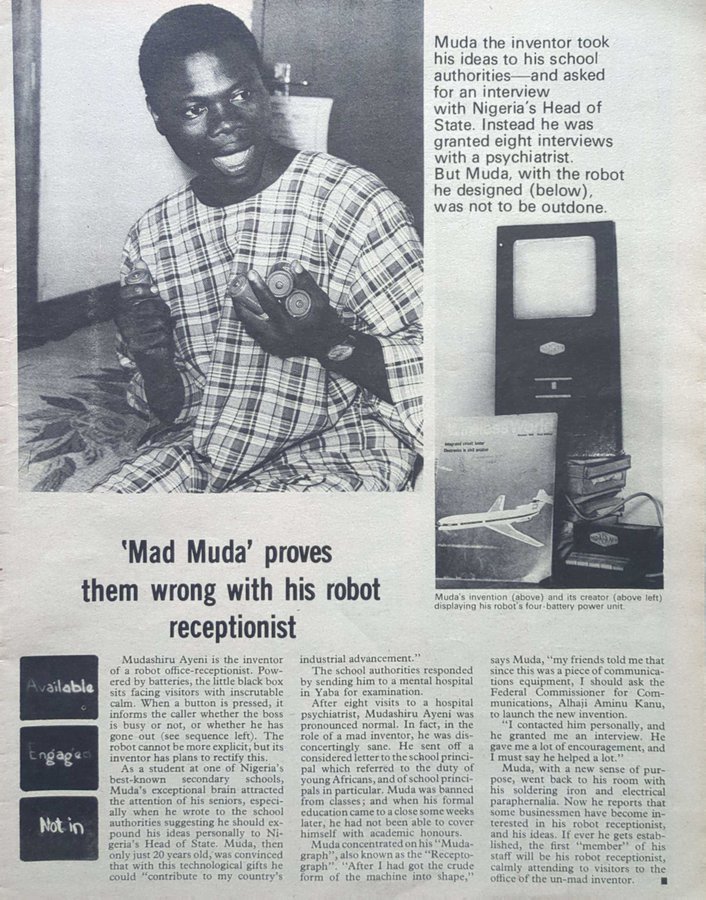
Mudashiru Ayeni Attempting AI In 1971 Was Sent To The Psychiatric Hospital
In the sweltering heat of early 1970s Lagos, while Nigeria was still licking the wounds of a brutal civil war and General Yakubu Gowon held the reins of power, a 20-year-old secondary school student named Mudashiru Ayeni was quietly revolutionizing what we now call Artificial Intelligence (AI).
Armed with nothing but wires, four batteries, and an unyielding belief in Nigeria’s future, Ayeni built a battery-powered “robot receptionist” he christened the Mudagraph—or Receptograph. At the press of a button, this ingenious contraption could announce to callers or visitors whether “the boss” was available, busy, or away from the office.
Today, we’d hail it as a precursor to chatbots and automated assistants like Siri or Alexa. Back then? The authorities called him mad.
Connect With NaijaChoice News for faster News updates.
- Whatsapp Channel: NaijaChoice News
- X (formerly Twitter): @NaijachoiceNGA
- Telegram: @NaijachoiceNGA
According to a riveting feature in the November 1971 edition of TRUST magazine—dug up from dusty archives and now viral on social media—Ayeni’s bold dream to demonstrate his invention personally to Head of State Gowon landed him not in a lab, but at Yaba Psychiatric Hospital, famously known as “Yaba Left.”
He endured eight grueling psychiatric evaluations over several weeks before doctors finally certified him “of sound mind.” But the damage was done.
The young visionary, a student at one of Nigeria’s elite secondary schools, penned a passionate letter to his principal, urging that young Africans must lead the continent’s development through science and technology. The response? He was banned from classes and forced to drop out entirely.
“Back then, they called him mad,” reflects a recent Technext analysis of the saga. “Mudashiru Ayeni believed in what he was building. He believed it mattered and could help his country.“
But Ayeni wasn’t one to be broken. He reached out to a beacon of hope in the military government: Federal Commissioner for Communications, the late Alhaji Aminu Kano. The elder statesman, a champion of the masses, granted him an audience, listened intently to the young inventor’s pitch, and injected him with a fresh dose of purpose.
By the time TRUST magazine hit the stands, several forward-thinking businessmen had already expressed keen interest in commercializing the Mudagraph. Visions of offices staffed by machines, freeing humans for higher pursuits, were whispered in boardrooms.
Yet, like so many Nigerian prodigies before and after, Ayeni vanished from the public eye. No patents. No startups. No follow-up interviews. No obituary. Just silence. As Technext poignantly notes: “Mudashiru Ayeni disappears.”
A Glimpse into the Inventor’s World
Picture this: In a cramped room in post-war Nigeria, where electricity was a luxury and computers were the stuff of sci-fi novels, Ayeni tinkered away like a modern-day Thomas Edison. He loved dismantling old radios, dreaming of gadgets that could handle the drudgery of office life.
His Mudagraph was no sci-fi fantasy—it was practical genius. Powered by simple batteries, it used basic wiring to deliver pre-recorded responses. “Is the boss available?” a visitor would ask. Press a button: “Yes!” or “Busy!” or “Out!“
It was automation in its purest form, decades before the internet or microchips made it commonplace. In an era when Nigeria’s offices ran on human messengers and typewriters, Ayeni saw the future.
“He refined it further after initial setbacks, improving wiring and expressiveness,” the Technext report details. But in a society still reeling from Biafra and fixated on survival over innovation, his ambition was mistaken for delusion.
School authorities, wary of his “wild ideas,” shipped him off to the psych ward. The letter to his principal—advocating for Africa’s youth to drive progress—sealed his fate. Expelled, his education shattered.
Nigeria’s Lost Opportunity: From 1971 to AI Boom
Fast-forward to 2026. Nigeria is buzzing with tech: Flutterwave, Paystack, and Andela are global unicorns. AI startups are sprouting like iroko trees, powered by young minds in Lagos, Abuja, and even Warri. The Federal Ministry of Innovation, Science and Technology—evolved from the 1970 Nigeria Council for Science and Technology—now talks of “digital transformation.”
Yet, Ayeni’s story is a stark reminder of how far we’ve come… and how little we’ve learned.
In 1971, under Gowon’s regime, the military was building universities and research institutes. But grassroots inventors like Muda? They fell through the cracks. No grants. No mentors. No “innovation hubs.” Just skepticism and a one-way ticket to Yaba.
“Over 50 years later, his name only appears in scanned magazine pages and social media screenshots,” laments the Technext piece. “No digital trail or archives exist.”
This isn’t just history—it’s a cautionary tale for today’s Naija. How many “Mudashirus” are tinkering in bedrooms across the Niger Delta, building drones from scrap or apps from pure grit, only to face ridicule from “big men” who can’t see beyond their Mercedes?
Aminu Kano’s encouragement was a rare light in the darkness. Today, we need more of that: Government-backed incubators, angel investors who bet on local talent, and a cultural shift that celebrates our inventors, not institutionalizes them.
The Lesson for Naija’s Next Gen
Mudashiru Ayeni wasn’t chasing fame or fortune. He was chasing progress—for Nigeria, for Africa. His Mudagraph was a spark that could have ignited an industrial revolution in offices nationwide. Instead, it flickered out.
As AI reshapes the world—ChatGPT writing code, robots manning call centers—let’s honor pioneers like Ayeni by doing better. Support the kid in Ogun State coding a farm app. Fund the Warri engineer 3D-printing prosthetics.
Because if Nigeria killed its 1971 genius through neglect, we can’t afford to repeat the mistake in 2026.
Our innovators are our greatest asset. Let’s build the labs, not the asylums.
Sources: TRUST Magazine (1971), Technext24 (2026), social media archives from @StartArchiving and Nairaland discussions.
We’ve got the edge. Get real-time reports, breaking scoops, and exclusive angles delivered straight to your phone. Don’t settle for stale news. Join NaijaChoice NEWS on WhatsApp for 24/7 updates →
Join Our WhatsApp Channel