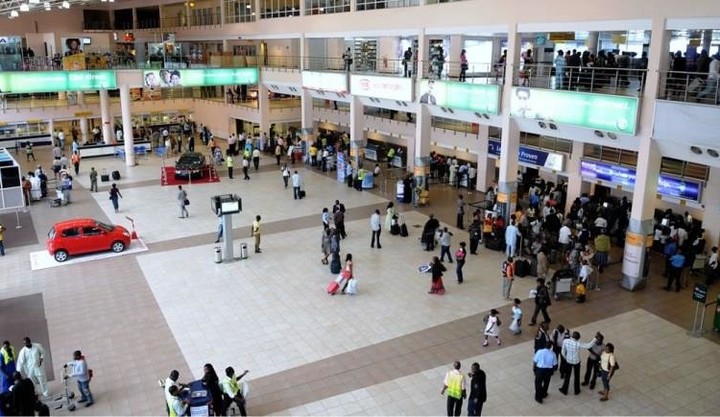
All international and domestic airports in Nigeria remain without reliable WiFi services for arriving and departing passengers, leaving travellers disconnected in an era where internet access has become a basic facilitation tool.
The Federal Ministry of Aviation and Aerospace Development allocated N800 million in the 2026 budget specifically to install WiFi at the country’s five international gateways — Murtala Muhammed International Airport in Lagos, Nnamdi Azikiwe International Airport in Abuja, Mallam Aminu Kano International Airport, Port Harcourt International Airport and Akanu Ibiam International Airport in Enugu — as well as selected domestic terminals.
NaijaChoice News checks across these facilities confirm that passengers, especially first-time visitors who rely on immediate connectivity to contact family, book onward transport or handle urgent business, are still left without this essential service.
Connect With NaijaChoice News for faster News updates.
- Whatsapp Channel: NaijaChoice News
- X (formerly Twitter): @NaijachoiceNGA
- Telegram: @NaijachoiceNGA
This situation stands in sharp contrast to neighbouring West African countries. At Ghana’s Kotoka International Airport in Accra, passengers enjoy free WiFi throughout the terminals by simply connecting to “KIA FREE WIFI”. Similar functional services are readily available at airports in Togo’s Lomé and Côte d’Ivoire’s Abidjan, where travellers can stay connected from arrival to departure without hassle.
Last week, MTN Nigeria, in partnership with the Federal Airports Authority of Nigeria (FAAN), announced the launch of free WiFi at the Murtala Muhammed International Airport Terminal 2 in Lagos and Nnamdi Azikiwe International Airport in Abuja. The telco stated it would fund the service through on-site branding while extending coverage to Port Harcourt, Enugu and Kano within the next three months.
However, NaijaChoice News visited Terminal 2 in Lagos shortly after the announcement and found the MTN WiFi network completely non-operational. No connection was available for passengers despite the widely publicised rollout.
Industry stakeholders have expressed deep frustration over the persistent failure. General Secretary of the Aviation Round Table Initiative (ARTI), Olumide Ohunayo, told NaijaChoice News that the absence of WiFi stems largely from long-standing inter-agency rivalry between FAAN and the Nigerian Airspace Management Authority (NAMA).
“What has stopped the provision of an effective Wi-Fi system in the past has been the back and forth between NAMA and FAAN over who should have control,” Ohunayo said. “NAMA works with legacy telecommunication equipment while FAAN, as the airport owner, has also failed to deliver within its purview. Technology has moved beyond old cables to modern fibre and optics. This is not a luxury but a necessity for passengers, not airport staff.”
He stressed that functional WiFi is critical for increasing passenger throughput and improving the overall airport experience.
Aviation security expert Capt. John Ojikutu (rtd), CEO of Centurion Security and Safety Consult, argued that non-aeronautical services like WiFi should be concessioned to private operators so government agencies can focus on core safety and regulatory duties.
“WiFi is a purely commercial service for passenger convenience, just like shopping malls, restaurants or toilets. It is not the responsibility of security agencies or ICAO obligations,” Capt. Ojikutu stated.
Capt. Muhammed Gbadamasi (rtd), former chief pilot of defunct ADC Airlines, expressed disappointment that in 2026, no Nigerian international airport can boast of working WiFi.
“Sadly, a significant amount of money has been wasted for no good reason. If so much has been spent, the contract for this service should be thoroughly investigated,” he said. “A proper airport-wide WiFi network must be handled by professional fibre cable providers, not quacks. Anyone found compromising standards must be prosecuted.”
Stakeholders pointed to a combination of technical challenges, bureaucratic bottlenecks, unreliable power supply, outdated infrastructure and unclear lines of responsibility between FAAN and NAMA as the root causes of the embarrassing situation.
NaijaChoice News notes that while the MTN-FAAN partnership offers hope of improvement in the coming months, the current reality on the ground shows that Nigerian airports continue to fall short of global and even regional standards in passenger facilitation.
Passengers and industry watchers are now calling on the Ministry of Aviation and Aerospace Development to ensure the budgeted funds deliver tangible results and that the MTN rollout becomes fully operational without further delay. Until then, Nigeria’s gateways remain disconnected — a clear embarrassment in West Africa’s aviation space.
We’ve got the edge. Get real-time reports, breaking scoops, and exclusive angles delivered straight to your phone. Don’t settle for stale news. Join NaijaChoice NEWS on WhatsApp for 24/7 updates →
Join Our WhatsApp Channel