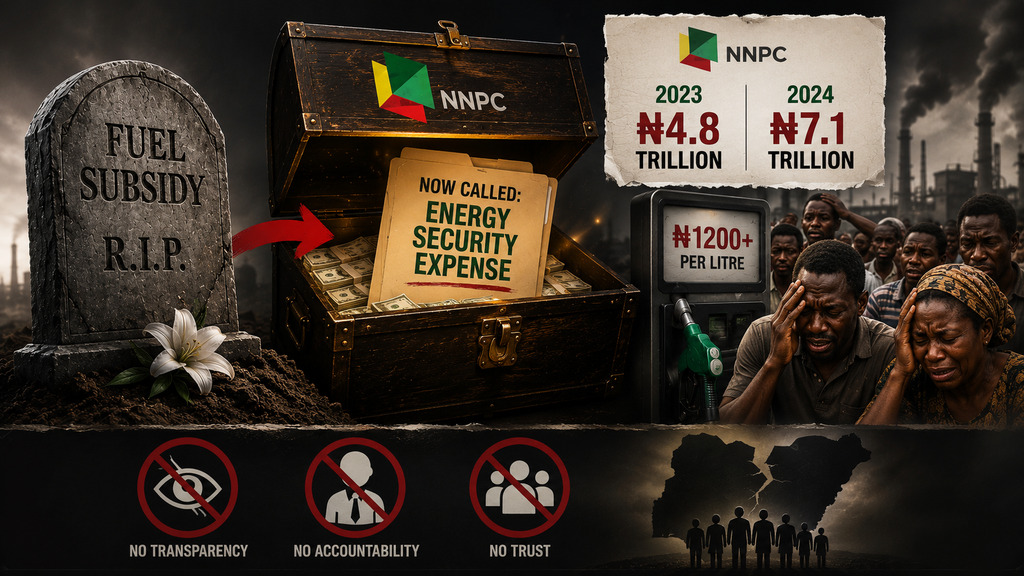
The Nigerian National Petroleum Company Limited (NNPCL) quietly absorbed ₦7.1 trillion in costs classified as “energy security expenses” in its 2024 audited financial statements, even as the federal government maintains that the fuel subsidy regime ended in 2023. This figure, up from ₦4.8 trillion in 2023, highlights the persistent gap between official policy pronouncements and the realities of fuel supply in Africa’s largest oil producer.
The expenditure forms part of a broader ₦17.5 trillion in energy-related obligations recorded by NNPCL for the year, including pipeline security, under-recoveries, and other commitments to maintain supply stability. Nigerians continue to grapple with pump prices hovering above ₦1,200 per litre in many areas, fueling widespread frustration over the cost of living more than three years after President Bola Tinubu’s landmark declaration that “the fuel subsidy is gone.”
The subsidy removal in May 2023 was a cornerstone of the administration’s economic reforms aimed at curbing fiscal deficits, redirecting savings toward infrastructure and social investments, and aligning with recommendations from international partners like the IMF and World Bank. Prior to the policy shift, the subsidy had become unsustainable, with claims of trillions lost annually to inefficiencies, corruption, and smuggling. The move triggered immediate price surges from around ₦200 to over ₦500 per litre within weeks, sparking protests and economic ripple effects across transport, food production, and manufacturing.
NNPCL, as the supplier of last resort, explains the “energy security expense” as arising from differences between modulated exchange rates used for pricing and actual costs at import settlement. Under the Petroleum Industry Act (PIA) 2021, such costs are recoverable from the Federation Account. Critics, including broadcaster Rufai Oseni, argue this is essentially a rebranded subsidy, pointing to the opacity in how these figures are managed and their limited visible impact on public welfare.
This development occurs against a backdrop of NNPCL’s reported strong performance, with ₦5.4 trillion profit after tax on ₦45.1 trillion revenue for 2024. However, the energy security line item underscores structural challenges: heavy reliance on imported petrol despite the Dangote Refinery’s operations, foreign exchange volatility, and vulnerabilities in the downstream sector. The corporation has also faced scrutiny over pipeline protection costs and remittances to the federation.
In Nigeria’s current context, where inflation has strained households and debt servicing competes with capital expenditure, the scale of these off-budget-like expenditures raises questions about fiscal transparency. The PIA was designed to commercialize NNPC operations and reduce fiscal burdens, yet persistent under-recoveries suggest the transition to a fully deregulated market remains incomplete. Greater private sector participation, including from local refineries, was expected to drive down costs and improve efficiency.
The ₦7.1 trillion outlay reflects the ongoing tension between maintaining energy affordability for citizens and achieving true market pricing. It also signals potential implications for future budgeting, as such costs could constrain resources available for critical sectors like education, healthcare, and security. Analysts note that clearer accounting and accelerated local refining capacity could help bridge the import dependency that sustains these expenses.
As public discourse intensifies around accountability in the oil sector, the NNPCL disclosures serve as a reminder of the complex trade-offs in Nigeria’s energy transition. Full transparency in managing these costs will be essential to rebuilding trust and delivering tangible dividends from the country’s vast petroleum resources.
We’ve got the edge. Get real-time reports, breaking scoops, and exclusive angles delivered straight to your phone. Don’t settle for stale news. Join NaijaChoice NEWS on WhatsApp for 24/7 updates →
Join Our WhatsApp Channel