- Operators raise concerns over potential uptick in fresh loan demands
- Naira may weaken as marketers stress-test FX liquidity
- $85/barrel spike worsens consumer plight
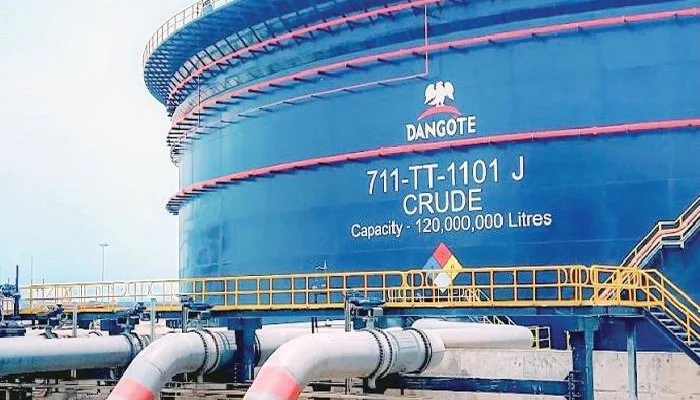
Petroleum marketers may require about $1.84 billion every month to purchase petrol, diesel and aviation fuel from Dangote Petroleum Refinery following the company’s decision to price refined petroleum products in dollars, a development analysts warned could increase pressure on Nigeria’s foreign exchange market, test liquidity position and expose consumers to more frequent fuel price fluctuations.
With the depot price of premium motor spirit (PMS) already increasing by over N100 per litre, the decision may also leave consumers with significant strain.
It is expected to stress-test the liquidity position of the foreign exchange (FX) and how fast it can respond to short-notice demand by largely fragmented marketers.
But with the marketers’ sourced dollar going directly to the local refinery in the new pseudo-import arrangement, the market is likely not going to witness significant FX leakage or loss through the new deal.
Based on current national consumption and supply volumes, marketers would need an estimated $60.7 million daily to procure products from the refinery. PMS alone accounts for the largest share of the demand, requiring about $36.9 million daily or roughly $1.1 billion monthly, at the refinery’s new gantry price of $0.779 per litre.
For automotive gas oil (diesel), priced at $1.087 per litre, marketers would require approximately $20.4 million daily, translating to about $633.5 million monthly.
As for aviation turbine kerosene (ATK), which is priced at $0.942 per litre, marketers would require another $3.4 million daily or around $105.1 million monthly, based on an average daily supply of 3.6 million litres.
Following the development, PMS price increased by about N100, rising N1,137 to N1,250 per litre in some depots, representing an increase of N113.
Sahara, AIPEC and African Terminal have reportedly increased their petrol loading prices from N1,090 to N1,120 per litre.
Diesel prices also climbed, with ex-depot prices rising to as high as N1,650 per litre, representing a spike of up to N150 per litre at some depots.
Coming a few days after the Federal Government called for a drop in petrol prices, pump prices have already witnessed about a N100 increase even as crude oil prices climbed to $85 per barrel or about $10 within the first two days of the week.
Dangote Petroleum Refinery had written to marketers announcing the transition of all gantry lifting payment currencies from the naira to the dollar effective July 13.
Consequently, any previously issued naira-invoice deals were voided, and payments against them ceased.
The notice seen by The Guardian announced new USD rates for Gantry (LTR), including PMS quoted at $0.779, AGO at $1.087 and ATK at $0.942. Coastal PMS pricing is $1,044.62 per metric tonne.
The refinery said the currency shift does not apply to LPG transactions, which will retain their existing payment arrangement. Customers were advised to adhere to the new guidelines for future dealings.
The development effectively transfers a substantial foreign exchange (FX) burden to downstream operators who earn revenue in naira but must henceforth source dollars to purchase products from the refinery, which plays the role of market leader.
The shift marks a significant reversal from the naira-based sales framework introduced after the Federal Government launched the naira-for-crude initiative in October 2024 to reduce pressure on the FX market, support domestic refining and strengthen energy security.
It is also not the first time the refinery has taken such a step. In April last year, Dangote Refinery similarly reverted to dollar pricing after raising concerns over inadequate supplies of crude under the naira-for-crude arrangement. The decision was reversed following engagements with the Federal Government.
Multiple industry sources, who spoke with The Guardian yesterday, said the latest move reflects growing difficulties in accessing crude locally, forcing the refinery to increasingly rely on imported crude.
An energy economist and founder of Energy Business Analytics, Dr Kaase Gbako, said the development suggests that the naira-for-crude arrangement was coming under increasing strain or that a larger share of crude feedstock was now being sourced externally.
According to him, the refinery has effectively transferred FX risk from crude suppliers to downstream marketers and ultimately consumers.
Gbako said pricing products in dollars would increase demand for FX, potentially weakening the naira and raising domestic fuel prices in local currency terms. He added that marketers were also likely to factor the cost of sourcing foreign exchange and possible delays into their pricing decisions, creating additional upward pressure on pump prices.
A professor emeritus of petroleum economics and Executive Director of the Emmanuel Egbogah Foundation, Prof. Wumi Iledare, said the development is consistent with the realities of a deregulated petroleum market where crude oil, the principal feedstock, is internationally traded.
He argued that while the policy provides commercial clarity and aligns domestic pricing with global market fundamentals, it introduces fresh operational and macroeconomic challenges.
According to Iledare, marketers would now need sophisticated FX procurement strategies alongside traditional product sourcing. Firms with stronger banking relationships, better liquidity and treasury management capabilities would enjoy a competitive advantage, he said.
He said marketers are also likely to shorten inventory cycles to minimise exposure to exchange-rate depreciation, resulting in more frequent procurement and potentially quicker adjustments in retail fuel prices, a situation that could increase price volatility.
Iledare maintained that future pump prices would increasingly reflect three major variables – international crude oil prices, refining and logistics costs as well as movements in the naira-dollar exchange rate.
However, Iledare stressed that price volatility should not be interpreted as policy failure but rather as an expected outcome of a competitive and deregulated market where prices respond to economic fundamentals instead of administrative controls.
To minimise price shocks, he advised marketers to improve inventory management, diversify supply sources, strengthen logistics efficiency, adopt foreign exchange risk management instruments where available and maintain adequate working capital.
The professor also argued that government’s role should focus on maintaining macroeconomic stability through improved FX liquidity, exchange-rate stability and increased domestic crude supply to local refineries rather than fixing fuel prices.
A former president of the Nigerian Economic Society (NES), Prof. Adeola Adenikinju, said the transition would fundamentally change procurement practices in the downstream sector.
He noted that marketers would now have to source dollars through the banking system before purchasing products, effectively making domestic procurement resemble fuel importation despite the refinery being in Nigeria.
Given the relatively inelastic demand for petrol, Adenikinju warned that the additional demand for foreign exchange could place further pressure on the naira if not carefully managed.
A weaker naira, he said, would have wider implications beyond fuel prices by increasing the cost of imported goods across the economy and worsening inflationary pressures.
He added that domestic fuel prices would now become much more sensitive to exchange-rate movements, increasing the speed with which currency depreciation translates into higher pump prices.
Country Manager for Tradegrid, Jide Pratt, said Dangote Refinery’s status as a Free Trade Zone enterprise provides a legal basis for conducting transactions in foreign currency.
However, he questioned why the refinery had reverted to dollar sales after previously operating successfully under the naira-based framework.
Pratt suggested that inadequate crude supply under the naira-for-crude arrangement remained the most plausible explanation.
He warned that the new pricing model would significantly alter financing arrangements for marketers, many of whom previously relied on bank guarantees for domestic transactions.
Instead, marketers may increasingly require standby letters of credit and other trade finance instruments, making transactions more complex and expensive.
Pratt also highlighted the challenge of currency mismatch, noting that marketers would purchase products in dollars but continue selling them in naira, exposing their businesses to exchange-rate risks and tighter cash flows.
He called for greater transparency around the implementation of the naira-for-crude programme, arguing that refined products produced from crude supplied under the arrangement should ideally continue to be sold in naira, while products refined from imported crude could legitimately attract dollar pricing.
“There needs to be a transparent framework linking crude sourcing with product pricing. Without that, uncertainty will persist,” he said.
Managing Director of the Centre for the Promotion of Private Enterprise (CPPE), Dr Muda Yusuf, also identified currency mismatch as the central challenge.
He said businesses generally face significant financial risks when operating costs are largely denominated in dollars while revenues are earned in naira.
According to Yusuf, the impact on fuel prices will depend mainly on exchange-rate stability and international crude oil prices.
He argued that if the exchange rate remains relatively stable, the shift to dollar pricing may not necessarily result in significant increases in pump prices.
Indeed, converting the refinery’s published dollar prices using the prevailing exchange rate produces figures broadly comparable to existing market prices.
Yusuf observed that the refinery’s decision was commercially understandable because a substantial proportion of its crude feedstock is imported and paid for in dollars, requiring corresponding dollar inflows from product sales.
Petroleum marketers, however, fear the policy could gradually dollarise Nigeria’s downstream petroleum market.
The National President of the Petroleum Products Retail Outlets Owners Association of Nigeria (PETROAN), Dr Billy Gillis-Harry, questioned whether marketers would now be expected to source dollars from the Central Bank of Nigeria (CBN) to purchase products sold entirely within the domestic market.
He warned that allowing a dominant market player to alter pricing structures without wider consultation could create uncertainty across the industry.
Similarly, the National President of the Independent Petroleum Marketers Association of Nigeria (IPMAN), Shettima Maigandi, said independent marketers would face considerable difficulties converting naira into dollars before purchasing products.
Although he said it was too early to determine the immediate effect on retail prices, he maintained that marketers would naturally prefer to continue buying products in naira since their sales are denominated in the local currency.
The stakeholders insisted that while the transition reflects commercial realities in a deregulated market increasingly linked to global crude trade, it also raises questions about the effectiveness of the naira-for-crude policy, the resilience of Nigeria’s foreign exchange market and the country’s ambition to deepen local value addition.
We’ve got the edge. Get real-time reports, breaking scoops, and exclusive angles delivered straight to your phone. Don’t settle for stale news. Join NaijaChoice NEWS on WhatsApp for 24/7 updates →
Join Our WhatsApp Channel