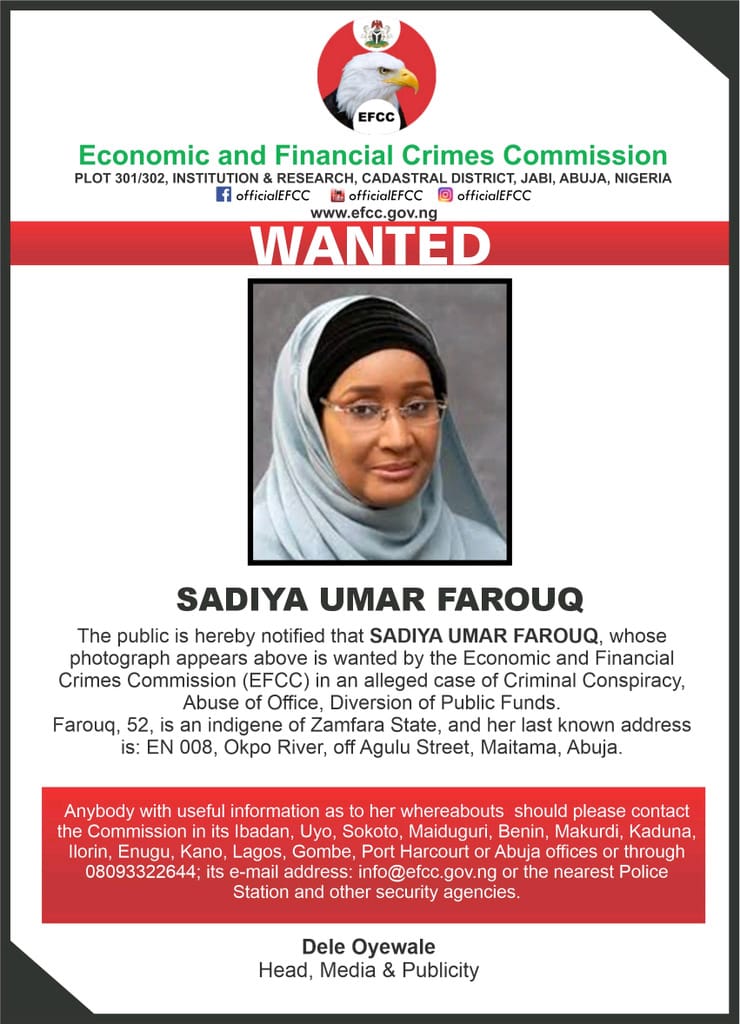
The Economic and Financial Crimes Commission (EFCC) has declared Sadiya Umar Farouq, former Minister of Humanitarian Affairs, Disaster Management and Social Development, wanted in connection with allegations of criminal conspiracy, abuse of office, and diversion of public funds.
Farouq, 52, who hails from Zamfara State, served as the pioneer minister of the portfolio created in 2019 by former President Muhammadu Buhari. Her last known address is EN 008, Okpo River, off Agulu Street, Maitama, Abuja. The anti-graft agency urged anyone with information on her whereabouts to contact its offices nationwide or through designated channels, including the hotline 08093322644 and email [email protected].
The development marks a significant escalation in long-running investigations into the management of social intervention programmes under her watch. These programmes included cash transfers, school feeding initiatives, and COVID-19 palliatives aimed at supporting vulnerable Nigerians. The EFCC has previously invited her for questioning regarding the handling of substantial sums, including allegations tied to over N37 billion in social intervention funds.
Farouq’s tenure as minister was frequently overshadowed by scrutiny. Lawmakers and civil society groups raised concerns over transparency in the disbursement of funds meant for the poorest citizens, especially during the height of the COVID-19 pandemic when millions relied on government support. In April 2026, a Federal Capital Territory High Court in Apo issued an arrest warrant after she reportedly failed to appear in connection with a 21-count charge involving alleged misappropriation of about $1.3 million and ₦746.6 million.
The Ministry of Humanitarian Affairs was established to coordinate national responses to poverty alleviation, disaster management, and social welfare. Critics often pointed to weak oversight mechanisms and the scale of resources involved — running into hundreds of billions of naira — as factors that made it susceptible to abuse. Farouq has at various times denied wrongdoing and cooperated with some invitations from the EFCC in the past.
This latest move by the EFCC comes amid renewed emphasis on accountability for public office holders, particularly those who managed high-stakes intervention funds during periods of economic hardship. It underscores ongoing efforts to recover diverted resources and deter similar practices, especially as Nigeria continues to grapple with widespread poverty and the need for effective social safety nets.
The declaration as a wanted person typically signals that standard invitations have not yielded compliance, potentially leading to broader alerts across security agencies and possible international collaboration if she is outside the country. It also places fresh spotlight on the prosecution of high-profile cases involving former officials.
The EFCC’s action reflects the continuing demand for transparency in the stewardship of public resources meant for Nigeria’s most vulnerable populations.
We’ve got the edge. Get real-time reports, breaking scoops, and exclusive angles delivered straight to your phone. Don’t settle for stale news. Join NaijaChoice NEWS on WhatsApp for 24/7 updates →
Join Our WhatsApp Channel