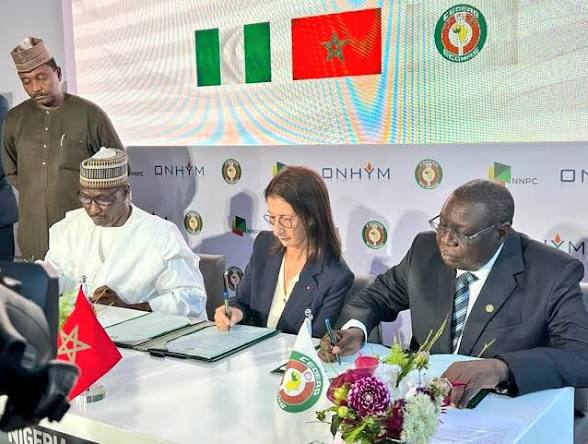
Nigeria and Morocco are advancing plans to formalise a landmark intergovernmental agreement for the African Atlantic Gas Pipeline this year.
The pact will lock in political and regulatory commitments for the $25 billion project, designed to move natural gas from Nigeria’s reserves across West Africa to Morocco and on to Europe.
Amina Benkhadra, Director-General of Morocco’s Office National des Hydrocarbures et des Mines, confirmed the timeline in a statement to Reuters on Monday. She said the deal will pave the way for stronger coordination among the 13 participating countries.
A high-level joint regulatory authority will be set up in Nigeria once the agreement is signed. It will bring together ministerial representatives from all involved nations to oversee political and regulatory matters.
The 6,900-kilometre pipeline, first conceived about a decade ago, has already cleared feasibility studies and front-end engineering design. It will run on a hybrid offshore-onshore route with an annual capacity of 30 billion cubic metres.
Roughly half of that volume – 15 billion cubic metres – is earmarked for domestic use in Morocco and exports to Europe. The rest will support energy needs across West Africa.
Benkhadra explained that the project will roll out in phases. Each segment can operate independently, delivering early economic benefits without waiting for a single global final investment decision.
A joint venture between the Nigerian National Petroleum Company Limited and Morocco’s hydrocarbons agency will create a dedicated project company. This entity will handle financing, construction and overall execution from a base in Morocco.
Investor interest is high, though final funding details are still being finalised through a mix of equity and debt.
The pipeline enjoys full backing from the Economic Community of West African States. Initial sections will link Morocco with gas fields in Mauritania and Senegal, while later segments will connect Ghana, Côte d’Ivoire and other coastal states to Nigeria’s vast reserves.
First gas flows are targeted for 2031.
For Nigeria, the project offers a fresh route to monetise its huge gas resources and grow non-oil revenue. It also strengthens the country’s regional leadership and supports broader industrial and power generation goals across West Africa.
NNPC Group Chief Executive Officer Bashir Bayo Ojulari has described the initiative as commercially viable and profitable, noting that the phased model allows stranded gas from several countries to feed into the network.
The development comes as Europe looks to diversify its energy supplies amid shifting global dynamics. For Nigeria, it marks another step in positioning the nation as a key player in Africa’s energy future and a reliable supplier to both regional and international markets.
We’ve got the edge. Get real-time reports, breaking scoops, and exclusive angles delivered straight to your phone. Don’t settle for stale news. Join NaijaChoice NEWS on WhatsApp for 24/7 updates →
Join Our WhatsApp Channel